
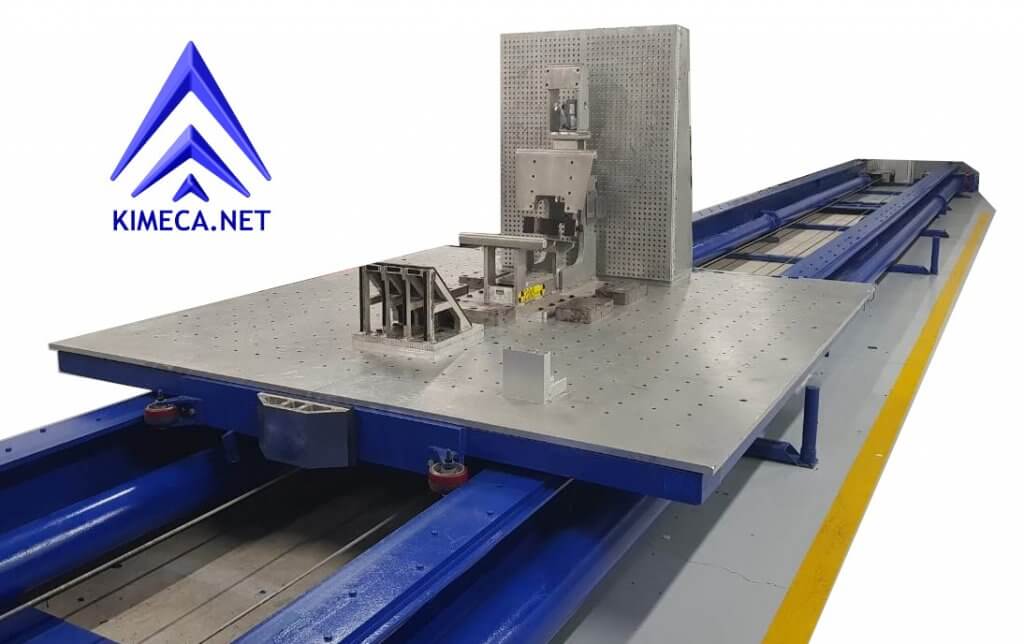

Sled Testing System
The most cost-effective way for a car’s components subjected to frontal crash conditions is functional verification. For the development of vehicle occupant protection systems for vehicles and similar applications, Kimeca has developed a crash test sled system that is also used for development and testing of frontal, side, and head airbags, vehicle and aerospace seats, seat belt systems, and other interior parts, and also is used to test components such as high-voltage batteries, locks, hinges, and fastenings to secure loads under real-life conditions.
Sled testing allows engineers to reproduce the dynamic conditions of a full-scale crash event in a controlled environment and at a fraction of the cost of a crash test. Typically, such tests are conducted to represent a simple frontal collision. However, even very complex crash events, such as those resulting from impacts between two moving vehicles, can be modeled using a sled system.
Dynamic simulation sled testing can represent various automotive collision conditions. Acceleration conditions during sled testing are readily reproducible and can be tuned to simulate collision events that occur during vehicle impacts with a fixed barrier or vehicle. Sled tests are conducted on automotive vehicle bodies or other structures to obtain valuable information. This information can be used to evaluate the dynamic performance of, but not limited to, vehicle restraint systems, vehicle seating systems, and body closure systems.
Standards Supported
- ECE-R16
- ECE-R17
Testing Challenges:
- Dynamic testing, high-energy environments
- Wide range of test articles, including restraint systems (seat belts, airbags), automotive/airplane seats, child safety seats
- Test instrumentation that supports a variety of applications
- Synchronizing high-speed cameras, triggers, power, and communication
- Able to withstand high-g pulses, wide sensor support
- Reliability and repeatability of data sets
Sled Testing System or Sled Crash Test
ComponentsPropulsion or Launching System
The propulsion system uses pressurized air to launch the sled to the desired velocities. To reach the desired velocity, the user must specify a pressure value in an HMI (Human Machine Interface) and press the start button. The control systems (Siemens PLC) start the test cycle:
- Extract the damper rod
- Move the sled to the starting end ot the tracks (opposite side of the impact position)
- The sled stops reaching the launching point
- Compressed air starts increasing pressure until the specified value at the HMI
- PLC monitors the air pressure, and when a certain pressure is reached,
- Control systems release sled
The propulsion system has really good accuracy and repeatability.


Decelerator: Hydraulic Variable Damper
Maximum Mass to decelerate: 2.5 Tons @ 100 km/h impact speed
Maximum Deceleration: 100g @ 100 km/h impact speed
Aluminum Gravity Cast Sled
It is a lightweight aluminum sled with very good strength and just 450 kg in mass. It can withstand crashes of 50 km/h impact velocity and 30g deceleration.


Steel Sled
Very strong sled for critical crash conditions: 100 km/h impact velocity, 100g deceleration, and 2000 kg payload.


Crash Lighting System
Kimeca has developed complete sled crash systems, including the lights. Our Lighting systems are tailored according to customer needs. The above images show our modules with eight powerful LEDs that can be synchronized with high-speed cameras and have the following features:
- 80,000 Lumens
- 160 Lumens/W
- 500 Watts
- CRI: 70 -> 97
- CCT: 1750°K -> 6500°K (Warm -> Cold)

Control System
- PLC
- Human Machine Interface (HMI)
- Sensors
- Actuators

Need More Information?
Sled RFQ
hybrid iii dummy
Powerbase wheelchair and occupant subjected
Validation of a powerbase wheelchair
¿Qué significa crash test?