
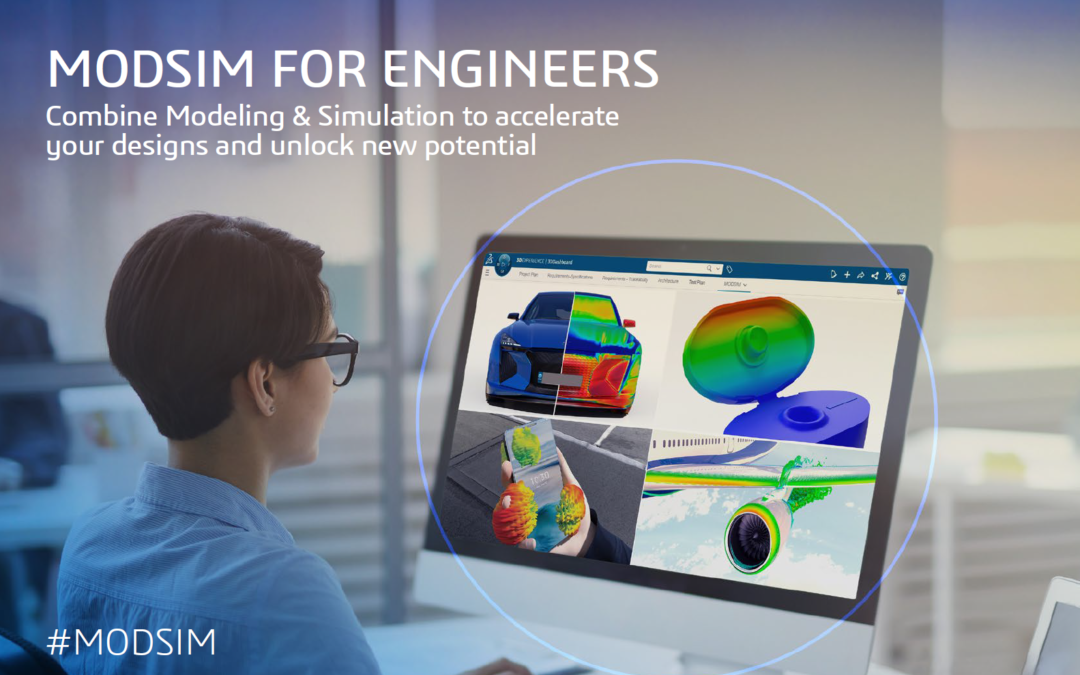
MODSIM FOR ENGINEERS
INTRODUCTION: What is MODSIM?
MODSIM on Dassault Systèmes’ 3DEXPERIENCE® platform is a unique next-generation engineering & design paradigm that completely unifies modeling and simulation. This merging of two traditionally distinct disciplines provides opportunities to significantly accelerate design exploration, optimization, and validation, and can
also unlock new innovations. Since the design model is also the virtual twin used for simulation, MODSIM returns analysis much earlier in the development cycle, before any physical testing has been done. This unlocks innovation, reduces design risk, cuts development costs, and speeds time-to-market.
Other benefits:
- Common model build
- Automated modeling
- Design in your comfort zone
- Automatic simulation set-up
- Democratization
- Single source of truth
- Platform integration
In this post, we will explore some of the benefits of MODSIM for engineers. Regardless of what industry you work in, MODSIM empowers designers and analysts to work smarter and unlock their innovation.
MODSIM IN PRACTICE A team of engineers has been tasked with developing a new electric drive system for a car (see below). In this ebook, we will show how MODSIM speeds up this process, supports innovation, and reduces risk throughout development. |
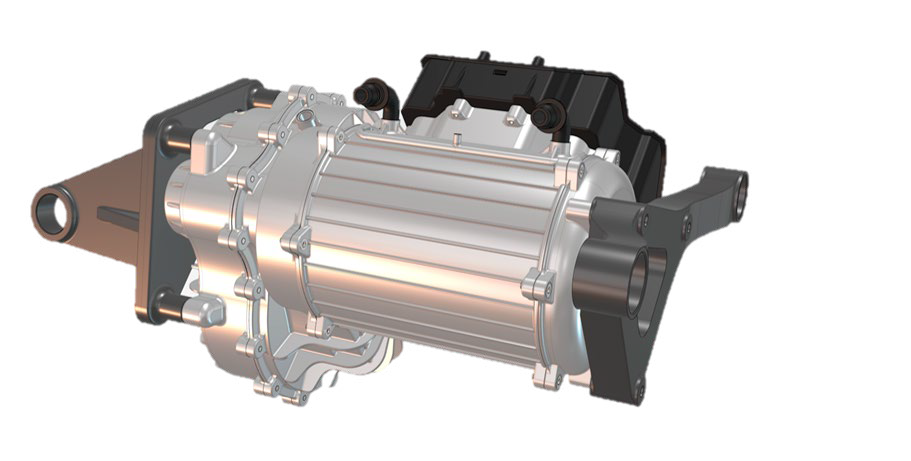
The motor geometry is designed in CATIA and ready for simulation.
COMMON MODEL BUILD CAD-CAE ASSOCIATIVITY
Under MODSIM, the model only needs to be built once. The same data can be used for all design and analysis tasks, saving time and development costs and reducing project complexity.
Faster model build:
MODSIM unifies the data model behind the modeling (CAD) and simulation (CAE), so there is full associativity between CAD and CAE.
Model-based systems engineering (MBSE):
Requirements, design intent, analysis, and other comments can be embedded in the model, providing context to the design so all users can understand the purpose of different components and the rationale behind the design.
Interoperability:
Users can work seamlessly with all stakeholders, including partners, suppliers, consultants, and others, bringing significant efficiency savings over today’s disconnected legacy systems.
Change management:
Testing, requirement changes, product delivery plans, and milestones are tracked and managed within a single integrated environment.
MODSIM IN PRACTICE While developing an electric drive system, a vibration analysis reveals unacceptable noise levels. The motor is |
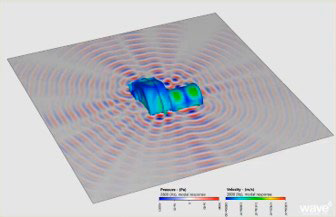
Vibro-acoustics simulation of the motor for noise and vibration analysis.
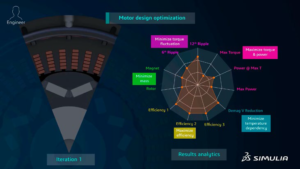
MODSIM IN PRACTICE When designing a motor, engineers aim to maximize energy efficiency in its expected operating regime. An automated optimization fine-tunes the placement of magnets and air gaps to improve performance, and the changes to the design can even be immediately reflected in the CAD file. |
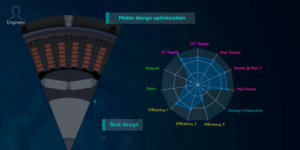
AUTOMATED MODELING
Designers can take advantage of simulation even in the earliest phases of development to nutlsc their concept and build their CAD model.
Easy data reuse:
With all the design and analysis data stored in one place, it is easy to take an existing design and use it to create a new project for the next iteration of a product line.
Automatic synthesis:
The user specifies the requirements, and the synthesis tool generates a potential design, using simulation to optimize and fine-tune its behavior.
Design optimization:
Two main forms of optimization exist: parametric and non-parametric:
MODSIM IN PRACTICE Suppliers use various CAD tools to design the components of the electric drive system, and even within the company, different sites use different software. Multi-CAD means that engineers don‘t have to worry about this—they simply receive the geometry they need for their job. |
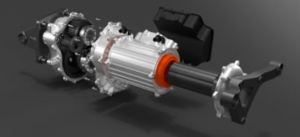
Exploded view of the motor CAD, showing the different components.
DESIGN IN YOUR COMFORT ZONE (MULTI CAD)
Multi-CAD is a software-agnostic approach to MODSIM: Geometry from tools such as CATIA, SOLIDWORKS, Siemens NX, and PTC Creo can be integrated into a single model.
Overcome vendor lock-in:
Learning a new tool requires significant time and commitment from the user, which can make it difficult for engineers to join a new company or collaborate with partners using different tools.
Stay up to date:
Change management tools mean that updates to the geometry in the 3rd party CAD tool can be automatically pushed to the Multi-CAD environment (Single Source of Truth).
Multiphysics simulation:
As part of the MODSIM framework, Multi-CAD also provides complete support for physics simulation; regardless of the tool used to build the model, it can be simulated. The best CAD tool for the job: Engineers can use the tool that works best for themselves and their projects.
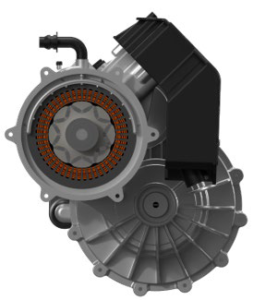
MODSIM IN PRACTICE The motor design arrives as a detailed 3D model, but for electromagnetic analysis, only a 2D cross-section of the coils and magnets is required. With a few clicks, the relevant parts of the motor can be extracted and prepared for simulation. |
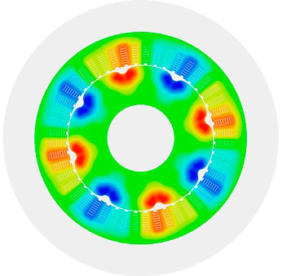 |  |
2D electromagnetic simulation of the motor in motion, extracted from the 3D model.
AUTOMATED SIMULATION SET-UP
MODSIM automates set-up processes, reducing the work needed to generate results. With predefined
templates, users can start their analysis straight away and get the key performance indicators (KPIs) that they need.
Automated processes include:
Data transfer:
- Collect the relevant data and gather it together, potentially converting file types and dealing with updates and new versions of old models.
Assembly:
- In a car, for example, the body shell, motors, and interior are designed largely by independent teams; many different components need to be integrated into a single model for a full system analysis.
Geometry clean-up and defeaturing:
- Detailed CAD models include tiny design elements that do not affect behavior but significantly increase the computing time for simulation; in others, the CAD model may miss relevant details or include faceting errors that distort simulation results.
Meshing and solver set-up:
- Most types of simulation discretize the model and the space around it into many small elements; this process is called meshing, and a balance needs to be struck between meshing fine enough to represent the model accurately, but not so fine that the simulation takes too long.
MODSIM IN PRACTICE The engineer investigating motor vibro-acoustics identifies a potential change that improves the noise but might affect durability. They are empowered by simulation templates to make an initial analysis of the impact of the change before speaking to the structural engineers. |
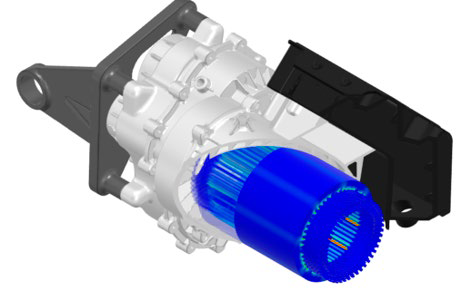
Durability simulation of the motor.
DEMOCRATIZATION
MODSIM democratizes engineering teams. All members of the team can have input on the design
and analysis, meaning that no one’s perspective is missed. This can help to highlight unexpected
problems or to provide an innovative idea that gives a competitive advantage.
Break down silos:
Slow communication, risk of misunderstandings, version control issues, and inefficient designs are some of the results of engineers working in isolation from each other.
Unlock skills:
CAD and CAE skills are often seen as separate specialisms, and designers and analysts are treated as very different roles; in reality, however, engineering often requires design and analysis, and being able to make use of both can accelerate product development as well as boost the user‘s personal career development. With MODSIM, the tight integration and automation of modeling and simulation mean that designers can also be analysts and vice versa.
MODSIM IN PRACTICE Midway through the project, the requirements change. Everyone on the team is notified and sees the new |
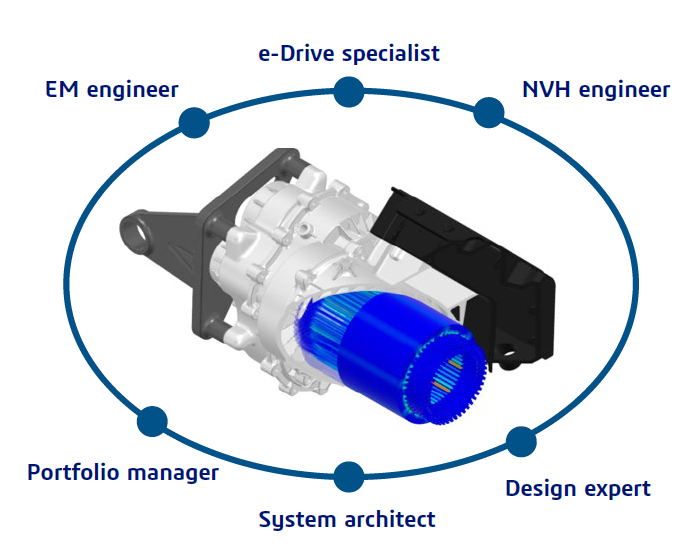
SINGLE SOURCE OF TRUTH
As the project progresses, new versions of files are created, and the changes need to be propagated
through the entire team to ensure that everyone is working with the latest data. The solution to
this problem is to store all project data in a single source of truth. This means a centralized storage
on the cloud or an internal server.
Reliable archives:
Different types of files need to be managed during product development—each may come from a different source and have several authors; the files are kept up to date, and older versions are archived.
Confidentiality and trade secrets:
Even if all data is stored in one place, access controls ensure that sensitive files can be protected from unauthorized access.
Reduced development risk:
Building a MODSIM workflow on a single source of truth platform means that users know they are working with the latest model files and do not accidentally integrate older versions into the model.
MODSIM IN PRACTICE The motor has to meet the strict standards of OEMs and regulators, which means there are numerous design |
PLATFORM INTEGRATION
Several different software tools can be involved in a MODSIM process beyond the modeling and simulation tools:
- Automation
- Requirements tracking
- Project planning
- Communication
- Collaboration
- Report generation
- Manufacturing process design
- Visualization
Integrating these tools on a single platform can accelerate the development process and reduce the risk of bottlenecks and communication issues.

EXECUTIVE SUMMARY
MODSIM integrates modeling and simulation into a single seamless process in which all stakeholders can participate in the engineering digital transformation. MODSIM reduces the effort and resources needed to design a new product and analyze and optimize its performance. Engineers can use MODSIM to build a Virtual Twin of the product, which accurately represents the real product and replicates its performance in simulation—this enables virtual testing that accelerates development, cuts risk, and reduces reliance on physical prototypes.
Automation speeds up both model building and simulation set-up, allowing engineers to avoid tedious tasks such as geometry healing and meshing and concentrate on the important tasks. MODSIM is multi-CAD—many leading CAD tools can be integrated into the MODSIM process—each stakeholder can use the software that best
suits their needs without compatibility issues.
With all users collaborating on a common platform and all data stored in a single source of truth, the risk of miscommunication and version control problems is greatly reduced. If simulation reveals an issue with the design, the model can be quickly changed and the updated geometry automatically distributed to all users.
Dassault Systèmes offers a powerful MODSIM solution suitable for engineers across all industries. With design tools such as CATIA and SOLIDWORKS and simulation tools from SIMULIA, including Abaqus, CST Studio Suite, PowerFLOW, and Simpack, all integrated on the 3DEXPERIENCE® digital engineering platform, engineers can take full advantage of the
Power of MODSIM to accelerate development and unlock innovation.
Simulia regional user meeting
the dexperience platform
Modeling and simulation